

What We're Reading
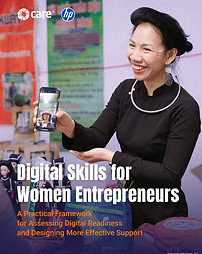
Access to digital tools doesn't automatically mean the ability to use them for business. CARE's Digital Skills Framework helps identify where women entrepreneurs are starting from — across four levels from Pre-Digital to Advanced — and what their next practical digital step should be, based on their business reality and context.
Ultimately, this framework is a step toward more intentional digital access and use. It helps CARE and its partners design digital skills programming that is segmented, practical, women-centered, and grounded in real business needs — so that women entrepreneurs can use digital tools safely, confidently, and with greater control over their economic futures.
Entrepreneurship research increasingly seeks to explain how systemic change towards gender inclusivity unfolds. Drawing on a critical realist case study, we develop a morphogenetic account of how such change becomes possible within entrepreneurial ecosystems through structural and cultural conditioning, social interaction, and structural and cultural elaboration. We show that bonding and bridging function as collective, agential mechanisms through which women and their allies reflexively contest gendered constraints and mobilise resource gatekeepers, thereby enabling shifts in ecosystem norms and practices over time. By doing so, the study bridges women’s entrepreneurship, ecosystem scholarship, and critical realism through a processual explanation of change.

Green finance represents both a critical challenge and a transformative opportunity for CAREC countries. In this publication, alignment of financial systems with climate and sustainability objectives is explored, focusing on how this can boost long-term economic stability. The possibilities created by a regional approach, with harmonized regulations and expanded use of instruments such as green bonds and tax incentives to mobilize private capital, are discussed in context of global best practices. A 10-year phased, coherent regional approach is presented as the pathway to shift investment flows to low-carbon and climate-resilient sectors.

The report outlines the various WSME segments and profiles, along with their financial and non-financial needs. It also provides market sizing insights and presents three country case studies: Pakistan, Uganda, and Colombia. The accompanying Toolkit offers a step-by-step guide to help financial intermediaries tailor products for different WSME segments, support funders in assessing risk and targeting high-potential businesses, and assist BSOs in designing segment-specific programs. It includes practical guides and tools across six steps—from analyzing the WSME landscape to customer segmentation, service demand assessment, solution design, and building the business case.

This paper examines whether automatic credit approval can reduce gender bias in lending to small and medium-sized enterprises. The study team collaborated with a bank in Peru that piloted a new screening tool to generate psychometric credit scores. Applicants who scored above a predefined threshold were automatically offered a loan with a size tied to their score, and those below the threshold were assessed by a loan officer.
Using a regression discontinuity design and credit bureau data, the paper compares loan offers and loan sizes of female and male applicants within a narrow window around the automatic approval threshold. The results show that female applicants below the threshold are less likely to take out loans and receive smaller loan amounts than men. However, this gender bias disappears for applicants above the threshold, suggesting that automated screening methods can reduce loan officer discretion and promote gender equity in lending.

This paper analyzes the impact of digital connectivity on the incomes of households headed by women in Viet Nam. It provides insights into the inclusive effects of digital connectivity and policy recommendations for advancing digital infrastructure development.
The paper finds that households headed by women benefit more on average from digital connectivity than those headed by men. The impact is stronger among lower-education, lower-income, and rural households. Income gains are potentially driven by greater job participation, particularly in services. The findings suggest that accelerating digital connectivity in less developed areas can deliver greater inclusivity benefits.

Women lead a large share of micro and small businesses across low- and middle-income countries, yet their enterprises remain smaller and less profitable than men’s. Many run smaller firms, work in informal markets, and possess little or no collateral. These barriers affect women’s ability to obtain and control capital—particularly larger loans—even as grants, microcredit, and digital lending proliferate.
Despite a growing body of rigorous studies on the impacts of grant and credit interventions, evidence on how capital affects women entrepreneurs remains fragmented. Existing reviews have either been limited in scope or have not systematically examined gender differences. As a result, important policy questions remain unresolved— including whether women entrepreneurs benefit from capital, which groups benefit most, which forms of capital are most effective, and the conditions under which these gains are sustained.

This report explores how members of the Association of Southeast Asian Nations (ASEAN) can shift rapidly to a more sustainable growth model through investments that reduce pollution, enhance resource efficiency, and protect natural capital.
It looks at the current state of the green economy transition in ASEAN, examining green economy metrics, job creation, policies and regulations, and investment opportunities. It identifies gaps and offers recommendations for policymakers. The report notes the need for country-specific strategies, while underscoring the power of regional cooperation and shared ambition. It was prepared in collaboration with the Philippine Department of Trade and Industry.

Key Messages
-
ADB scaled up its operations in 2025, committing $29.3 from its own resources to help Asia and the Pacific navigate change and turn challenges into opportunities. The bank’s commitment represents a 20% year-on-year increase and was boosted by an additional $14.7 billion from partners. ADB also accelerated institutional reforms and policy updates to make the bank faster, stronger, and more responsive.

-
ADB sharpened its focus on promoting private sector development as a key driver of inclusive, resilient, and sustainable growth. ADB’s 2025 investments across Asia and the Pacific are expected to generate more than 3.3 million jobs. Half of ADB’s public sector commitments directly support infrastructure, reforms, and institutions to unlock private investments.
-
ADB’s operations committed in 2025 will improve infrastructure, financial services, and agricultural productivity that are projected to benefit about 120 million people; approximately 61 million people are expected to benefit from improved health care services, education provision, or social protection; and ADB’s operations are expected to directly help improve the living standards for more than 9 million people living in poverty and vulnerable situations.
-
ADB advanced the environment and nature agenda across Asia and the Pacific in 2025. It supported 17 developing member countries to enhance nature-based solutions that strengthen resilience, protect biodiversity, restore coastal and marine ecosystems, reduce pollution, and promote nature-positive supply chains.
New data from the World Bank’s Women, Business and the Law (WBL) project provide the first cross-country baseline on how income tax systems integrate gender in law, tax administration, and fiscal reporting. Drawing on information from 81 economies, the data examine three core areas: (1) personal income tax filing rules; (2) tax provisions that treat women and men differently; and (3) tax administration and reporting practices, including sex-disaggregated data and gender analysis in tax expenditure reports. The findings show that tax systems may overlook realities specific to women, leading to unequal outcomes for women and men. The Brief highlights policy options for governments seeking to ensure that tax systems work equitably for women and men. These options include shifting toward individual taxation and removing family-based provisions that disadvantage secondary earners; reviewing and phasing out tax measures that differ for women and men; investing in sex-disaggregated tax data systems; and integrating gender into tax expenditure reporting and incidence analysis. This Brief is the first in a three-part series on gender and fiscal policy. Subsequent Briefs will examine gender-responsive budgeting and synthesize lessons across taxation and spending.

Despite significant strides toward gender equality, women around the world continue to encounter systemic obstacles that hinder their entrepreneurial success. This paper systematically reviews the literature on the barriers female entrepreneurs face and the solutions proposed to overcome these challenges. It discusses institutional factors, financial factors, human capital factors, and social and cultural factors. The literature overview is complemented by a series of stylized facts that illustrate how overcoming some of these existing barriers is correlated with improved women’s entrepreneurship and female labor force participation, drawing on the World Bank’s Women, Business and the Law database as well as the World Bank’s Enterprise Surveys. The findings underscore the need for creating an enabling environment where women can thrive as entrepreneurs.

Despite making up 34% of businesses, women-owned MSMEs continue to face a staggering $1.9 trillion financing gap in emerging and developing markets. The hurdles are familiar: a lack of collateral, limited credit history and digital footprint, gaps in the legal environment and banking policies, and a mismatch of products and services. In many markets, financial institutions have overlooked women and women-owned enterprises as a distinct asset class, despite their pivotal role in driving economic growth and job creation across the manufacturing, tourism, agribusiness, and services industries.

This playbook provides practical guidance for advancing women’s financial and digital inclusion. It explores the key barriers women face, from social norms and skills gaps to market and policy constraints, and outlines concrete actions stakeholders can take to address them.
Designed for policymakers, financial service providers, and development practitioners, the playbook offers frameworks, examples, and actionable recommendations to help design more inclusive policies, programs, and financial solutions for women.

Women-owned and women-led MSMEs (W-MSMEs) represent an estimated 38 percent of MSMEs globally, yet they face persistent financing gaps, partly because most countries lack robust gender disaggregated MSME data.
Strengthening these systems enables evidence-based policy, inclusive finance, and improved risk oversight. This toolkit helps strengthen gender responsive MSME data systems by providing practical guidance, assessment tools, and good practices. It supports policymakers, regulators, and data producers seeking to integrate gender considerations into MSME definitions, indicators, and reporting frameworks.

This report offers the latest global assessment of how laws, policies, and practices shape women’s economic opportunities across 10 topics relating to their working lives: Safety, Mobility, Work, Pay, Marriage, Parenthood, Childcare, Entrepreneurship, Assets, and Pension.
This 11th edition of Women, Business and the Law introduces methodological refinements that capture not only laws on the books but also the policies and institutions that support their implementation, as well as expert perceptions of whether those laws translate into real-world practices.

This brief examines how unpaid childcare responsibilities limit women’s time, mobility, and opportunities to launch and scale businesses across diverse country contexts. While legal reforms are improving, major gaps remain in the availability, affordability, and implementation of quality childcare services. The paper emphasizes that investing in childcare—alongside addressing gender norms and supporting care-sector entrepreneurs—is essential for boosting women’s economic participation. It positions the care economy as both a development priority and an untapped market opportunity.

This joint report by ERIA, ADB, and METI examines the evolving role of transition finance, technology, and policy in supporting the decarbonisation of Southeast Asia’s emissions-intensive sectors such as power and heavy industry – the so-called ‘high emissions’ and ‘hard-to-abate’ sectors, respectively. These sectors are highlighted in high-level roadmaps that identify key investment areas for a pragmatic energy transition.

This report provides insights on the structural and gender-specific barriers faced by micro, small, and medium-sized enterprises in Cambodia and highlights potential solutions.
Drawing on extensive data and stakeholder insights, it reveals how unequal access to knowledge, finance, and networks can hold back enterprises owned by women. The report sets out targeted policy recommendations for inclusive economic development where women entrepreneurs are empowered to lead in the digital and green economy.

This paper analyzes the dynamics of microfinance in Georgia, combining household survey results with financial and policy data to assess how the sector supports poverty reduction and inclusion.
It identifies structural and regulatory barriers and proposes ways to expand microfinance services. It offers insights for policymakers, financial institutions, and development partners seeking to promote inclusive growth.

This report aims to shed light on the demand, availability, risks, constraints, and opportunities related to Pacific women entrepreneurs’ access to insurance. The research presented will contribute to informing the formulation of recommendations to strengthen the capacity of PICs to deliver insurance products that build women’s resilience, support their entrepreneurial activities, and promote broader economic empowerment.

This publication reviews the landscape of micro, small, and medium-sized enterprises (MSMEs) in 26 countries in Asia and the Pacific. Accompanied by a database, it aims to support policymakers in promoting MSME development and resilience.

Based on evidence from over 400 MSMEs, it shows how micro businesses are less likely to use technology in their operations and highlights how skills shortages, cybersecurity concerns, and inadequate infrastructure affect adoption. It explains the need to target women entrepreneurs and examines how a comprehensive strategy that involves personalized training, better access to digital expertise, and stronger digital finance programs can increase skills and drive inclusion.

Closing the financing gap for women owned/led micro, small, and medium enterprises (WMSMEs) represents a multi-trillion-dollar business opportunity for the financial services industry. But as with all customer segments, tapping into the WMSMEs opportunity requires data, which is critical to understand the unique needs and preferences of women entrepreneurs and to properly serve them.

This working paper explores how inclusive systems and financial tools can help vulnerable populations better withstand and adapt to escalating climate shocks. It highlights the untapped potential of leveraging existing social protection frameworks, such as digital registries and cash delivery systems, to channel climate finance more quickly and equitably to those most at risk. Drawing on real-world examples and evidence, the paper argues that integrating climate funds with established social safety nets and inclusive financial services can expand reach, improve efficiency, and strengthen long-term resilience outcomes for households and communities facing climate impacts.

Cyber Resilience for Financial Inclusion
Threat Landscape Report
This report highlights significant cybersecurity gaps among organizations working to expand financial services to underserved communities across the Asia-Pacific region. The assessment found widespread issues such as misconfigured systems, weak web and email security, and exposed credentials, leaving both organizations and the vulnerable populations they serve at heightened risk. The report emphasizes that strengthening basic cyber hygiene, adopting multi-factor authentication, and improving overall security practices are essential to protect financial inclusion efforts from disruption and exploitation.

The newly released Global Entrepreneurship Monitor (GEM) 2024/2025 Women’s Entrepreneurship Report: Navigating Challenges, Driving Change reveals that while women entrepreneurs continue to demonstrate remarkable resilience and innovation, they still encounter persistent barriers that hinder their full participation in the entrepreneurial ecosystem.
Drawing on insights from 161,528 adults across 51 countries, this year’s report sheds light on these challenges—highlighting, among other findings, the differing reasons women and men cite for closing a business.

This report examines the issues and policy solutions used around the world to develop women’s entrepreneurship financing. It is aligned with the principles of the OECD Council Recommendation on SME Financing, which underlines the need to develop a wide range of financing options for entrepreneurs and recognise differences between different entrepreneur profiles, and builds on the findings of the OECD flagship report Financing SMEs and Entrepreneurs Scoreboard as well as broader OECD work on women entrepreneurship, including the report on Entrepreneurship Policy through a Gender Lens.
By evaluating gender-specific factors across economies, the index highlights how successful female entrepreneurs contribute to economic and social development. It also assesses domestic strengths and weaknesses in cultivating supportive environments.